EV chargers for tenants in flats and HMOs: a landlord's guide
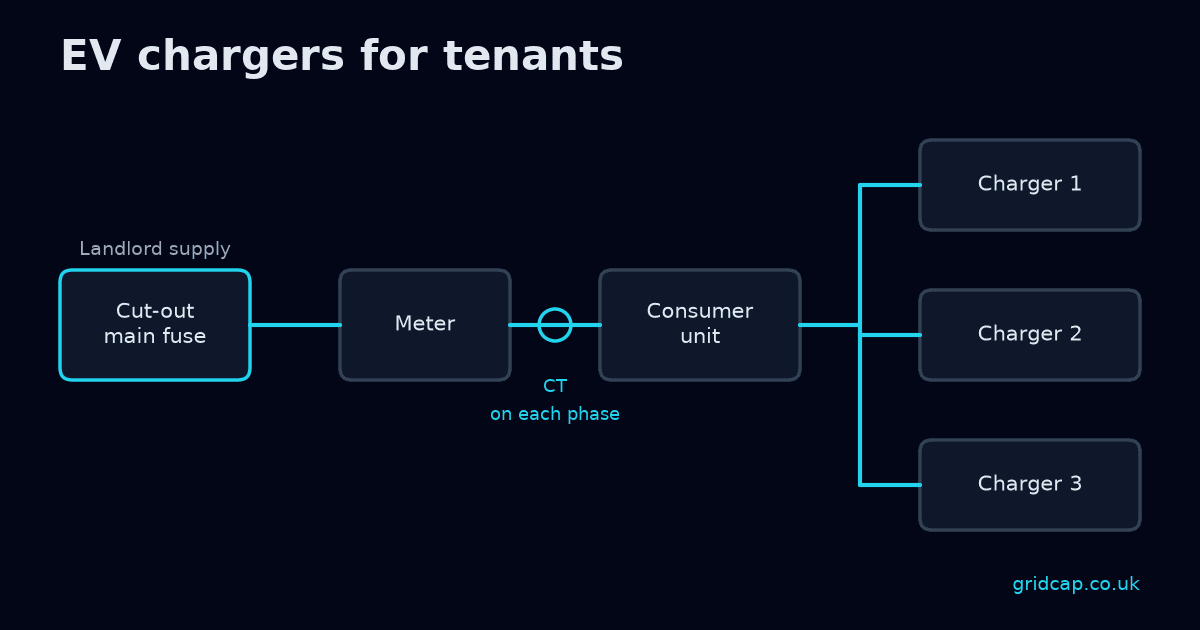
More tenants are asking for somewhere to charge an EV. For a landlord with a block of flats or an HMO, the first question isn't which charger to buy. It's which supply the chargers will run from, and whether that supply has room.
Which supply will the chargers use?
In many blocks each flat has its own supply, and there's a separate landlord supply for shared areas such as lighting and door entry. Shared car park chargers usually run from the landlord supply, or from a new supply. In an HMO there's often one supply for the whole building.
Find out which supply you're working with and its main fuse rating. Our guide to finding your main fuse rating explains how to do it safely.
Add up demand per phase
The limit applies per phase. Work from the busiest phase's peak, not the average across the three. Half-hourly meter data is a 30-minute average, so short peaks run higher; add a margin before comparing it with the fuse.
Rough currents:
- a 7 kW single-phase charger draws about 32 A on one phase
- an 11 kW three-phase charger draws about 16 A per phase
- a 22 kW charger draws about 32 A per phase
On a three-phase supply, spread single-phase chargers across the phases rather than putting them all on one.
Connect first, or apply first?
A single charger within 60 A per phase on a supply that isn't looped can usually connect first. More than one charger means applying first. See our guides to telling the DNO about your EV charger and looped supplies.
Load management for several chargers
EREC G100 load management can cap the chargers so the site stays within its limit. It needs a current sensor (CT) on every phase and must fail safe. More than one charger is more than connect and notify covers, so it's a DNO application first. G100 load management can cap them so the supply copes, and that goes in the application. See what G100 is.
Worked example
These figures are an illustration only.
A landlord wants three 7 kW chargers in the car park of a small block, run from a three-phase landlord supply. The busiest phase peaks at, say, 20 A, plus a margin, as half-hourly meter data is a 30-minute average.
Putting all three chargers on one phase would add about 96 A to it, well over 60 A. Spreading them one per phase adds about 32 A to each, so the busiest phase reaches about 52 A before the margin. That is close to 60 A, so the margin decides it. With three chargers, the installer applies to the DNO first. If the margin leaves too little room, G100 load management could cap the chargers, and that goes in the application.
What Gridcap covers
The free check shows whether the supply looks green, amber or red for what you plan to add. For amber and red, the £49 report sets out the per-phase calculation and, where needed, the G100 limit. It gives your installer the evidence they need for the DNO application. Gridcap can't tell whether a supply is looped.
FAQ
Can tenant chargers run from the landlord supply? Often, if it has room. Check its main fuse rating and per-phase peak first.
Do I need to tell the DNO? Yes. The question is whether the installer notifies after installing or applies first.
Can load management let me fit more chargers? It can cap chargers to stay within the limit, but it needs a CT on every phase, must fail safe and still goes to the DNO.
Check your supply for free
Enter the main fuse rating and the chargers you plan to add, and see whether your supply looks green, amber or red. Run the free supply check.