How to find your main fuse rating
Before adding an EV charger, a heat pump or anything else that draws a lot of power, the first number to find is the main fuse rating. It sets how much current the whole property can draw from the network. This guide explains where to look, what the figure usually is, and what to do if you can't read it.
Where to look
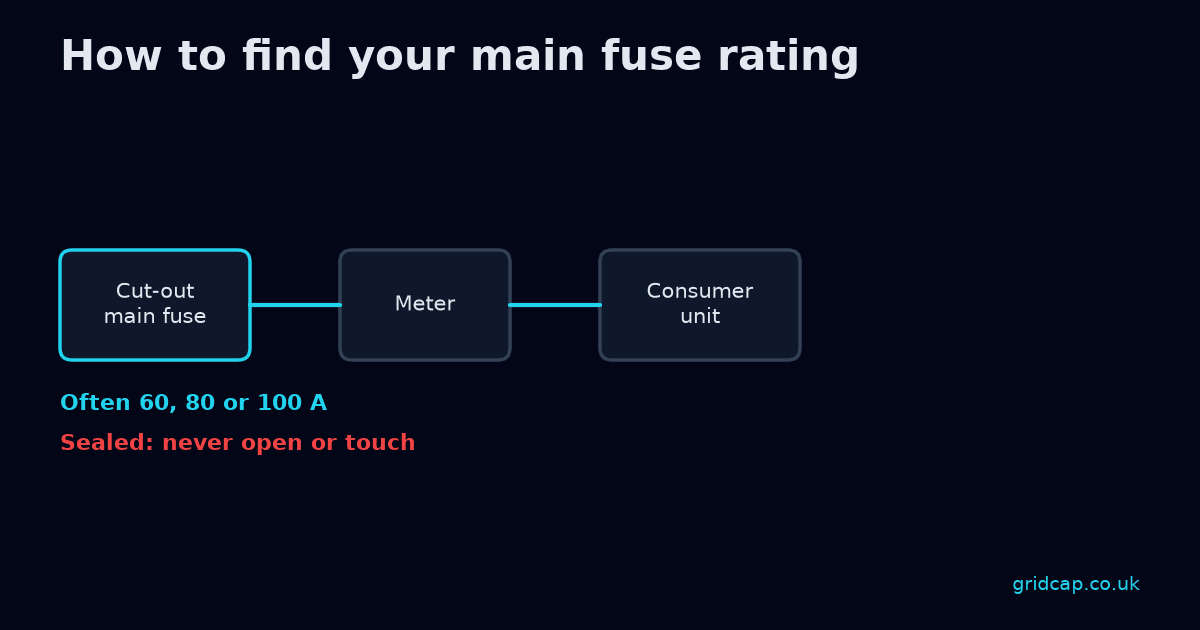
The main fuse sits in the cut-out, the sealed unit where the supply cable from the street enters the property. It's usually next to the electricity meter, often in a meter cupboard, under the stairs, in a garage or in an outside meter box.
The rating is normally printed on the fuse carrier in the cut-out. Common ratings are 60, 80 or 100 A.
Look, but never touch
The cut-out belongs to your distribution network operator (DNO) and is sealed. Never open, remove or touch the cut-out or the fuse carrier. Look at it from the outside only. If the label isn't visible without touching anything, stop there and use one of the options below.
A photo taken from a safe distance is fine, and it's useful to send to your installer.
The label isn't always the whole story
The rating printed on the carrier isn't always the fuse inside it. A carrier might say 100 A while holding a smaller fuse, for example. If the figure matters for a job, and for a charger or heat pump it usually does, ask your DNO to confirm the main fuse rating. They hold records for the supply and can tell you what's fitted.
What if I can't see it at all?
That's common. Labels fade, cupboards are dark and some cut-outs are boxed in. You can:
- ask your installer to note it at the survey, without opening anything
- ask your DNO to confirm it
- if you can't confirm it, enter the most likely rating in the Gridcap free check and get the DNO to confirm it before relying on the result
Why the rating matters
Every job that adds a big load comes back to this number. A 7 kW charger draws about 32 A, which is more than half of a 60 A supply on its own. Whether a job can usually connect first and notify the DNO afterwards, or needs to apply first, depends on how the total demand compares with 60 A per phase. Our guide to telling the DNO about your EV charger explains the two routes.
Worked example
These figures are an illustration only.
A landlord wants a 7 kW charger at a rental house. Through the meter cupboard door they can see "60 A" printed on the fuse carrier, and they send a photo to the installer without touching anything. The charger alone would use about 32 A of that 60 A. Because the carrier label isn't always the fuse inside, the installer asks the DNO to confirm the rating before relying on it.
FAQ
What is a main fuse rating? It's the size of the fuse in the cut-out, and it limits how much current the property can draw from the network.
What are typical ratings? Often 60, 80 or 100 A.
Can I open the cut-out to check? No. It's the DNO's sealed equipment. Look from outside only, or ask the DNO.
The carrier says 100 A. Is that definitely my fuse? Not always. The carrier label isn't always the fuse inside, so ask your DNO to confirm.
Can my installer change the main fuse? No. The cut-out and main fuse are the DNO's equipment, so any change goes through the DNO.
Check your supply for free
Once you have a likely rating, enter it with what you plan to add and see whether your supply looks green, amber or red. Run the free supply check.