Can I add a battery with my EV charger?
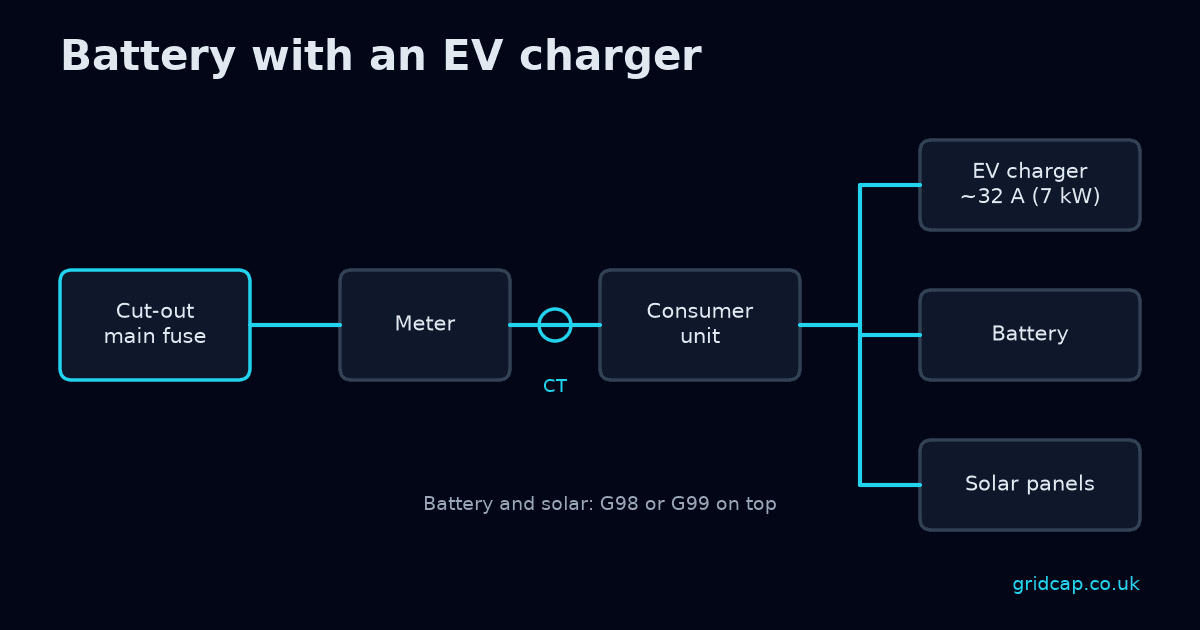
Often, yes, but a battery isn't just an add-on to the charger job. It changes the paperwork, and it can change the numbers. This guide explains the two things to plan for.
A battery counts as generation
A home or business battery can send power back into the property and, depending on how it's set up, towards the network. Solar panels do the same. So both count as generation.
That means G98 or G99 applies on top of the charger. The charger is one conversation with the DNO about demand. The battery or solar is another about generation. G98 covers small type-tested systems up to 16 A per phase in total across all generation on site (about 3.68 kW single-phase). Anything bigger, or not type-tested, is G99, which means applying first.
A battery can add to demand as well
When a battery charges from the grid, for example overnight on a cheap tariff, it draws current like any other load. If that happens while the car is charging, the two add together on the same supply.
So when working out peak demand, include:
- the EV charger: a 7 kW charger draws about 32 A
- the battery's charging current from the grid, from its datasheet
- the property's existing peak, plus a margin, as half-hourly meter data is a 30-minute average
If the total stays within 60 A per phase and the supply isn't looped, the charger can usually be connected first and then notified. Above that, the installer applies to the DNO first. Our guide to telling the DNO about your EV charger covers the two routes.
Can load management help?
EREC G100 load management can turn the charger down to keep a site within its limit. With a battery as well as the charger, plan on applying first. The battery also needs G98 or G99. G100 load management can manage the battery's grid charging as well as the charger, if the equipment supports it. See what G100 is.
Worked example
These figures are an illustration only.
A small business on a single-phase 60 A supply is adding a 7 kW charger and a battery.
- EV charger: about 32 A
- Battery charging from the grid: say 15 A
- Existing peak: say 20 A, plus a margin
Total: 32 + 15 + 20 = 67 A before the margin. That is over 60 A, so the installer applies to the DNO before installing. Separately, the battery is generation, so G98 or G99 applies on top.
If the battery were set to charge only when the car isn't, the overlap might go away. The installer should confirm that with the equipment and the DNO.
What Gridcap covers
The free check asks about batteries and solar too and flags whether the generation looks like G98 or needs G99. The installer handles the G98 or G99 paperwork separately from the demand side. For amber and red results, the £49 report gives your installer the evidence they need for the DNO application on the demand side.
FAQ
Does a home battery need DNO paperwork? Yes. A battery counts as generation, so G98 or G99 applies.
Is that separate from the charger? It applies on top of the charger. Your installer can tell you how the two are handled.
Can a battery increase my peak demand? Yes, when it charges from the grid. That current adds to the charger and everything else.
Does solar count too? Yes. Solar panels are generation, so G98 or G99 applies.
Check your supply for free
Enter your main fuse rating and what you plan to add, and see whether your supply looks green, amber or red. Run the free supply check.