Heat pump and EV charger on one supply: will both fit?
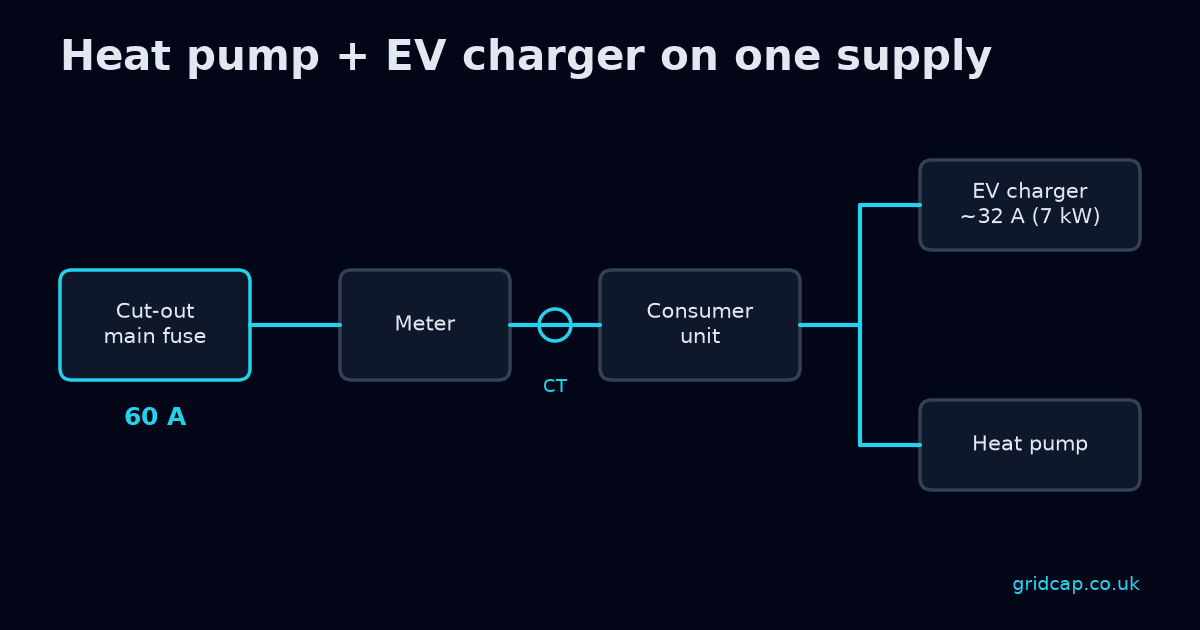
More homes and rental properties are getting a heat pump and an EV charger at around the same time. Each one on its own is often fine. Together, on a typical 60 A single-phase supply, they can push the property over its limit. This guide explains how to add them up, when the DNO has to approve the job first, and how load management can often avoid a supply upgrade.
If you only have a charger to add, our guide to a 7 kW charger on a 60 A supply covers that on its own. This page is about the combination.
Start with the charger
A 7 kW charger draws about 32 A on its own. On a 60 A supply that is more than half the fuse rating before anything else is switched on.
The heat pump: use the coldest day
A heat pump draws the most current at its design temperature, the coldest outdoor temperature the system was sized for. That is also when it is least efficient, so it needs more electricity for each unit of heat.
The figure that matters is the electrical input at that design temperature, from the heat pump's datasheet. Don't use the heat output figure. A heat pump sold as "8 kW" usually means 8 kW of heat, and the current it draws from the supply is a different number.
Add the rest of the property
On top of the charger and the heat pump, add the property's existing peak demand. Put the three together and the total often goes over 60 A. When it does, the job needs a DNO application before installing, and sometimes a fuse or supply upgrade.
Worked example
These figures are an illustration only. Every property is different.
A landlord is fitting a heat pump and a 7 kW charger to a house on a 60 A single-phase supply.
- EV charger: about 32 A
- Heat pump electrical input at design temperature, from its datasheet: say 14 A
- Existing peak demand of the house: say 25 A, plus a margin, as half-hourly meter data is a 30-minute average
Total: 32 + 14 + 25 = 71 A. That is over the 60 A fuse, so this is a DNO application before installing.
Now suppose the charger uses EREC G100 load management, so it turns itself down while the heat pump is running. If that keeps the total within the limit the DNO agrees, the house may avoid a fuse or supply upgrade. The car still charges, just more slowly at busy times. The scheme still goes to the DNO as part of the application.
How G100 load management helps
G100 is the standard for customer load management schemes. A current sensor on the incoming cables measures what the property is drawing, and the charger turns down when the heat pump runs. This often avoids an upgrade, but it doesn't avoid the DNO. Adding both a heat pump and a charger is more than connect and notify covers, so it's usually a DNO application first. G100 load management can keep the property within its limit, and that goes in the application. Our page on what G100 is explains more.
Both the heat pump and the charger go to the DNO, and the installer can usually cover them together.
Solar panels and batteries
Solar panels and home batteries count as generation. If the property has or is getting either, G98 or G99 applies on top of the heat pump and charger questions.
What the Gridcap report gives you
The free check shows whether the supply looks green, amber or red for what you plan to add. For amber and red, the £49 report sets out the full calculation and, where load management is needed, the G100 operating limit. It gives your installer the evidence they need for the DNO application. The DNO makes its own assessment.
FAQ
Can I fit a heat pump and an EV charger on a 60 A fuse? Sometimes. It depends on the heat pump's electrical input at design temperature and the rest of the property's peak. Many combinations go over 60 A, which means a DNO application first.
Why can't I use the heat pump's kW rating? That figure is usually heat output. The supply sees the electrical input, which is highest on the coldest days.
Will I need a supply upgrade? Not always. G100 load management can turn the charger down when the heat pump runs, which often avoids one. It still goes in the DNO application.
I also have solar panels. Does that change anything? Yes. Solar and batteries count as generation, so G98 or G99 applies as well.
Check your supply for free
Enter the main fuse rating and what you plan to add, and see whether your supply looks green, amber or red. Run the free supply check.